
Accredited Boiler Training
Australia's recognised high-risk work licence training for boiler operators — accredited courses delivered by industry-leading trainers across multiple locations.
Comprehensive Accredited Boilers Courses for All Levels
O'Brien delivers the following High Risk Work Licence training courses. We pride ourselves on the calibre of our trainer/assessors and their ability to engage with students to be able to effectively deliver the outcomes of the training. With various locations around Australia, we have a solution for you and your training needs, whether it be an individual on a Public Course or a company who requires site training, we have an option for you. For further information on dates and locations please do not hesitate to contact our training department on training@obrien-energy.com
Comprehensive Accredited Boilers Courses for All Levels
| Course | Licence to Operate a Standard Boiler |
|---|---|
| Delivery Method | Classroom Based |
| Course Duration | 5 Days |
| Pre Requisites | Nil |
| Entry Requirements | Students must be over 18 years of age and be able to communicate effectively in the English Language. |
| Course Locations | Victoria, New South Wales, Queensland, Northern Territory, South Australia, Western Australia |
| Course Cost | $3,985 per person. Price listed is based on our Public Course rates. If you require training for a group, please contact us to obtain a quote. |
| Course | Licence to Operate an Advanced Boiler |
|---|---|
| Delivery Method | Classroom + Practical Workshop |
| Course Duration | 7 Days |
| Pre Requisites | MSMBLIC001 completion or equivalent industry experience |
| Entry Requirements | Students must be over 18 years of age and be able to communicate effectively in the English Language. Industry experience with boiler systems is highly recommended. |
| Course Locations | Victoria, New South Wales, Queensland, South Australia, Western Australia |
| Course Cost | $4,985 per person. Price listed is based on our Public Course rates. If you require training for a group, please contact us to obtain a quote. |
| Course | Licence to Operate a Steam Turbine |
|---|---|
| Delivery Method | Classroom + Site Visit |
| Course Duration | 5 Days |
| Pre Requisites | Nil |
| Entry Requirements | Students must be over 18 years of age and be able to communicate effectively in the English Language. Relevant industry experience preferred. |
| Course Locations | Victoria, New South Wales, Queensland (limited availability) |
| Course Cost | $4,485 per person. Price listed is based on our Public Course rates. If you require training for a group, please contact us to obtain a quote. |
Accredited Training
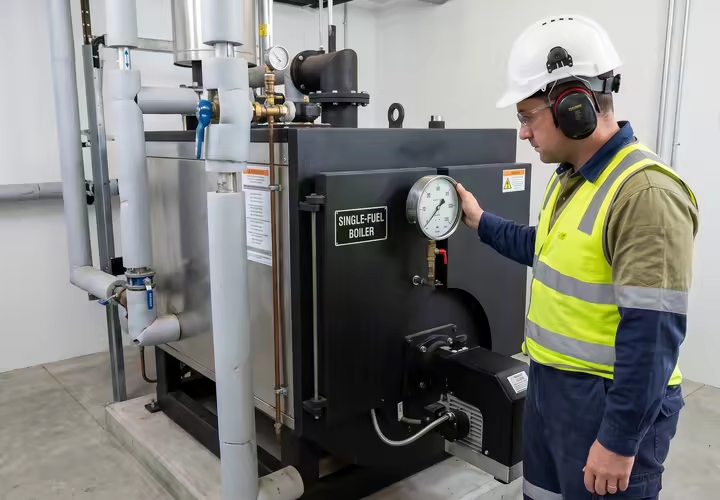
This course provides essential skills for the safe operation of a standard boiler, meeting high-risk work licensing requirements under WHS Regulations. Participants will learn boiler start-up, monitoring, shutdown, storage, and inspection procedures, focusing on single-fuel boilers without advanced components like superheaters or economisers. The course covers operational risk management, safety protocols, and adherence to national standards, ensuring only certified personnel operate or maintain standard boilers.
Advanced boiler operation training for boilers with superheaters, economisers, or multi-fuel capability. Builds on MSMBLIC001 foundation, covering complex system controls, advanced safety procedures, and operational optimisation. Required for HRW licence Class B operators handling industrial-scale steam systems.
Turbine operation HRW licence training. Covers principles of turbine plant operation, safety isolation, monitoring control systems, and emergency response procedures. Pathway for steam turbine operators in power generation and industrial process facilities.
Key Benefits
Recognition of Prior Learning
Recognition of Prior Learning (RPL) is a process where skills and knowledge that you have gained through work and life experience and other unrecognised training can be formally recognised. O'Brien has a process that has been structured to minimise the time and cost to applicants and provides a supportive approach to students wishing to take up this option. You should apply for RPL at the time of enrolment. During the entry process and interview stage O'Brien will discuss with you the process and options for RPL. Suitability is often determined on how much experience you have in a certain area, your work history and previous training. If RPL is determined as a possibility for you, you will be provided with a kit that will guide you in working through each unit to determine relevant skills and experience and identify whether you would be able to provide the required evidence. A trainer/assessor will be available to assist you throughout this process.

O'Brien Boiler Services Pty Ltd — RTO Registration 45484
Frequently Asked Questions
Accredited boilers refer to industrial or commercial boiler systems that meet specific safety, operational, and environmental standards established by regulatory bodies. These boilers are certified through rigorous testing and evaluation to ensure they comply with high-risk work licensing requirements and operational safety protocols. Accreditation ensures that the boilers are safe, efficient, and environmentally responsible, making them suitable for a variety of industries, including manufacturing, energy, and healthcare. Training programs for accredited boilers focus on equipping operators with the skills and knowledge needed to handle these systems safely and efficiently, adhering to Australian standards.
Accredited boilers meet rigorous safety and efficiency standards, reducing operational risk, lowering insurance premiums, and providing legal compliance with WHS regulations. They also improve fuel efficiency, reduce emissions, and extend service life — saving on maintenance and energy costs.
Yes. Accreditation requires continuous testing, documentation, and inspection protocols. Operators trained on accredited systems also follow standardised procedures, reducing human-error incidents and unplanned downtime.
Accredited boilers must demonstrate efficiency benchmarks during certification. Operators trained on these systems learn optimisation techniques such as combustion tuning, blowdown management, and heat recovery — typically delivering 5–12% fuel savings compared with non-optimised operation.
Inspection frequency depends on pressure class and jurisdiction. Australian standards typically require an external inspection every 2 years and an internal inspection every 4 years for Class B boilers. Daily operator checks, plus weekly maintenance, are standard practice for safe operation.